

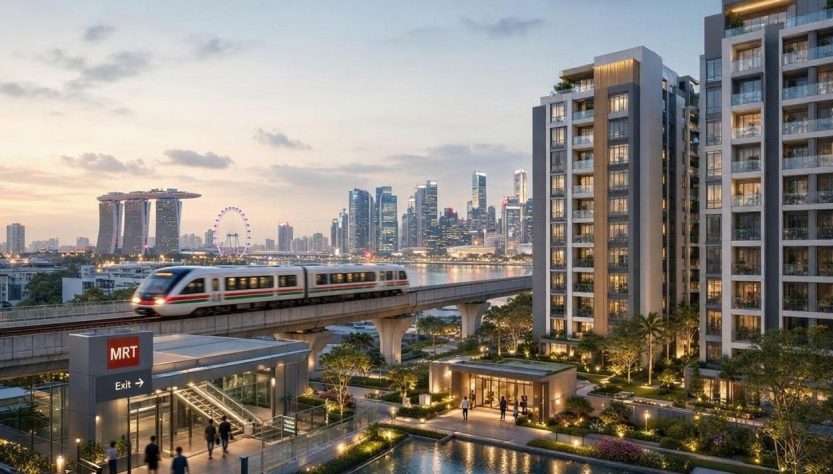
For many Singapore homebuyers, proximity to an MRT station is one of the first considerations when selecting a residential property. Convenient public transport can simplify daily commuting, reduce reliance on private vehicles and make it easier to reach workplaces, schools and commercial centres.
Properties located near MRT stations often attract attention from both owner-occupiers and investors. However, buying a home close to a train station does not automatically make it the best purchase. Buyers must consider the actual walking distance, surrounding environment, property price and their household’s transport needs.
Understanding these factors can help purchasers determine whether paying more for MRT accessibility is financially and practically worthwhile.
1. Why MRT Accessibility Matters to Homebuyers
Singapore’s public transport network plays an important role in everyday mobility. For households where family members work or study in different parts of the island, living near an MRT station can make commuting more manageable.
A shorter journey to the station may also reduce the time spent walking in hot or rainy weather. This can be particularly useful for families with young children, elderly residents and individuals who travel frequently.
MRT accessibility may also reduce the need for private transport. Households that primarily use public transport can potentially avoid some expenses associated with car ownership, including parking, insurance and maintenance.
However, convenience should be measured according to actual travel patterns. A household that works remotely may place less importance on immediate MRT access than someone who commutes daily to the Central Business District.
2. Understanding What Counts as Walking Distance
Property advertisements frequently highlight the distance between a development and its nearest MRT station. However, the stated distance does not always represent the actual walking experience.
For example, a property may be described as being 500 metres from an MRT station. Buyers should establish whether this measurement refers to a straight-line distance or the actual pedestrian route.
Several factors can influence accessibility:
- Pedestrian crossings: Multiple road crossings can increase walking time.
- Sheltered pathways: Covered walkways provide additional comfort during rainy weather.
- Road conditions: Busy roads and traffic junctions may affect pedestrian convenience.
- Station entrances: Different entrances can have significantly different walking distances.
- Accessibility features: Lifts and barrier-free routes are important for elderly residents and wheelchair users.
Before purchasing, buyers should physically walk from the development to the MRT station. This provides a more realistic understanding than relying exclusively on marketing materials.
3. Examining MRT Connectivity in Northern Singapore
The northern region provides useful examples of how transport accessibility can influence residential decisions.
Yishun and Sembawang are served by the North-South Line, connecting residents to several major destinations across Singapore. Buyers living in these districts can access established residential amenities while maintaining connections to other parts of the island.
One planned development worth examining is Chencharu Central Residences, a private mixed-use condominium at Chencharu Close in Yishun, District 27.
The development is being undertaken by Gamuda Land, Evia Real Estate and Ho Lee Group. It is planned as a 99-year leasehold project with up to approximately 875 homes. Its proposed facilities include a hawker centre, bus interchange and retail components. Khatib MRT is approximately 0.45 to 0.49km away.
The proposed bus interchange is another relevant consideration because it could provide additional public transport options beyond the MRT network.
For buyers comparing residential developments, this combination of rail and bus connectivity may be worth examining alongside the surrounding neighbourhood amenities.
4. Does Living Near an MRT Station Always Mean Paying More?
MRT proximity is an important property consideration, but it is not the only factor influencing market value.
A property’s pricing can also reflect its development age, remaining lease, floor level, orientation, unit size, facilities and surrounding commercial activity.
Two developments located at similar distances from an MRT station may have very different asking prices because of their individual characteristics.
Buyers should also consider potential disadvantages associated with immediate station proximity. Depending on the location and building orientation, nearby roads, transport infrastructure and pedestrian activity may contribute to noise or congestion.
A unit facing a busy road may provide a different living experience from one positioned towards an internal landscaped area.
Instead of assuming that the closest property is automatically the most desirable, compare the overall residential environment and the additional amount being paid for convenience.
5. When Park Connectors and Public Transport Work Together
Transport convenience is not limited to train stations. Pedestrian routes, cycling infrastructure and green corridors can also influence how residents move around their neighbourhood.
This is particularly relevant in Sembawang, where residential surroundings include recreational spaces and park connectors.
Fablewoode Residences is a planned executive condominium along Sembawang Road in District 27. Developed by Oriental Pacific Development, it is expected to comprise approximately 265 low-rise homes on a 99-year leasehold site.
Canberra MRT is approximately 0.5km away, and the development is next to the Sungei Simpang Kanan park connector. The site has a plot ratio of 1.4, with a reported land price of approximately S$692 psf ppr.
This illustrates another dimension of residential connectivity. While MRT access supports commuting, nearby park connectors can provide opportunities for walking and cycling.
Buyers should assess whether these facilities match their actual lifestyle rather than treating them as interchangeable benefits.
6. A Practical Checklist Before Purchasing
Before committing to a property near an MRT station, evaluate the following:
- Walk the route between the development and the station.
- Check the available train and bus connections to your regular destinations.
- Visit the property during peak commuting hours.
- Assess possible noise from nearby transport infrastructure.
- Compare prices with developments in the surrounding neighbourhood.
- Examine the property’s orientation, layout and remaining lease.
- Calculate mortgage payments and additional ownership expenses.
It is also helpful to consider future household requirements. A property that is convenient for a young working couple today should remain practical if their commuting patterns or family circumstances change.
Conclusion
MRT accessibility can improve everyday convenience and strengthen a property’s appeal, but it should not be the sole reason for purchasing a home.
Buyers should evaluate actual walking routes, transport connections, neighbourhood facilities and overall affordability before deciding whether a location justifies its asking price. The strongest property choice is one that balances connectivity with comfortable living and sustainable finances.